
Water Sort: Color Tube Puzzle
Flyfox GamesPuzzle
4.92.54K Reviews
- Version
- 1.5.7
- Installs
- 10.00M
- Age Rating
- Everyone
Screenshots





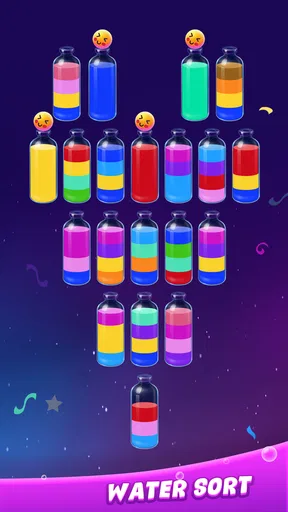


Our Review of Water Sort: Color Tube Puzzle
 Analysis by Appyee
I spent time with Water Sort: Color Tube Puzzle because its central idea is wonderfully simple: move colored liquid between tubes until every color is grouped correctly. That single capability sounds familiar, but the three-dimensional presentation changes how I read each board. I am not only solving a color arrangement; I am judging available space, protecting completed layers, and deciding whether a move will leave enough room for the next sequence.
That makes this a good example of a puzzle game that is easy to understand but not always easy to solve cleanly. It belongs to the puzzle category, comes from Flyfox Games, and is free to start. The age rating is Everyone, so the basic concept is approachable for children, adults, and anyone who wants a quiet logic exercise without learning a complicated control system.
The game has attracted a large audience, with a 4.9 average from around 558 thousand ratings and more than 10 million installs. Those figures do not automatically make every puzzle enjoyable, but they do suggest that the straightforward sorting format has broad appeal. In my experience, the strongest reason to try it is not the novelty of pouring liquid. It is the way the limited tube space turns ordinary color matching into a sequence of careful decisions.
Why the sorting ability matters more than the decoration
The most important feature here is the ability to pour one color into another tube and gradually build matching stacks. A move is useful only when the destination is empty or already has the same color on top, and the available space is always part of the problem. That rule creates a small planning challenge: a move can look productive while quietly blocking the colors needed later.
I like this format because it gives immediate visual feedback. When a color lands in the right place, the board becomes easier to read. You can see which tube is nearly complete, which tube is acting as temporary storage, and which mixed stack is likely to cause trouble. The three-dimensional view also makes the liquid layers feel more tangible than simple flat tiles, even though the underlying challenge remains a logic puzzle.
The real strength is controlled rearrangement, not speed. You are not required to memorize a long rule set or react to enemies. The useful skill is recognizing the difference between a safe move and a move that merely postpones the problem. That makes the game suitable for short breaks, but it can also pull me into longer sessions when a nearly solved board refuses to cooperate.
Reading a board before touching it
My most useful habit was to pause at the start of a puzzle and inspect the top layer of every tube. I look first for colors that can be joined immediately, then for tubes whose upper layers hide a color needed elsewhere. This prevents the common mistake of pouring simply because a legal move is available. Legal and helpful are not the same thing in this game.
I also try to identify the tube that will serve as working space. An empty tube is valuable, but using it too early can leave no room when a deeper layer needs to be exposed. If two pours seem equally attractive, I usually choose the one that opens a hidden color while preserving an empty destination. That small preference makes later decisions less cramped.
Another practical technique is to finish a color only when doing so does not seal away a useful route. A completed tube is satisfying, but it can also remove flexibility if the surrounding arrangement still depends on that space. I found that temporary disorder is sometimes better than premature neatness. The goal is not to make the board look organized after every move; it is to keep future options alive.
What a normal session feels like
The controls are built around tapping and pouring, so the learning curve is almost immediate. I can understand the interaction without a tutorial-heavy explanation, which is important for a casual puzzle. The visual action is also calming: select a tube, choose another, watch the liquid shift, and reassess the remaining layers.
That calm rhythm is the main reason I would use it during a short pause in the day. Imagine waiting for a train or taking a few minutes between tasks. One board gives enough focus to occupy the mind without demanding the commitment of a story game or a competitive match. If I make a poor choice, the mistake is usually understandable, so I can review the arrangement rather than feeling that the game cheated me.
At the same time, the relaxed presentation should not be confused with effortless play. Later arrangements can require several moves of preparation before a color reaches its final tube. I often have to think backward: which layer must move first, where can it rest temporarily, and which tube must remain open for the final transfer? That backward planning is where the game becomes more satisfying than a simple matching toy.
The best everyday use for this particular game
The strongest scenario is a quiet, interruption-friendly break. I can begin a puzzle, stop to answer a message, and return without losing a complicated control scheme or a large amount of story context. It works especially well for people who like visual order and small decisions, but who do not necessarily want a timer, combat, or social competition.
I would also recommend it as a gentle way to introduce logic puzzles to someone who finds traditional number puzzles intimidating. The colors and pouring action make the objective obvious, while the real challenge gradually comes from planning. A parent could hand it to a child who enjoys arranging objects, although younger players may need help understanding why an apparently correct pour can create a dead end.
For me, the best use is not endless background play while watching something else. The board deserves enough attention to notice the layers and preserve space. It is casual in presentation, but careless multitasking can lead to random moves and frustration. I get more from it when I treat each puzzle as a compact reasoning exercise rather than as an automatic tapping activity.
It is also a reasonable choice when I want a puzzle without a large download commitment or a complex account-based routine. The game is free, which lowers the barrier to trying it. However, free access does not mean every player will have the same relationship with it, especially if optional purchases become a concern. The listed in-app purchase range runs from $0.99 to $119.99 per item, so I would personally review the purchase screen carefully and avoid spending impulsively on a moment of frustration.
Where it differs from familiar puzzle alternatives
Compared with match-three games, this title is less about creating chains and more about preserving future space. A match-three board often rewards quick recognition and immediate combinations. Here, the best move may be the one that appears unproductive because it exposes a buried color or keeps a storage tube available. Players who enjoy planning several steps ahead may prefer this structure.
Compared with crossword or number puzzles, the challenge is more visual and spatial. There is no need to search for vocabulary or calculate an answer. The information is visible in the tubes, but the order of operations matters. That makes it accessible to people who like logic but do not enjoy text-heavy puzzles.
It is also different from physics-based pouring games. The liquid movement gives the game its tactile character, yet the main task is not controlling realistic flow. It is arranging color layers under restrictions. If you are looking for experimentation, simulation, or a story attached to the mechanic, this will likely feel narrow. If you want a clean sorting problem that can be understood in seconds, that narrowness is a benefit.
The tradeoffs I noticed while playing
The same simplicity that makes the game welcoming can eventually make it feel repetitive. The core action remains sorting tubes, so players who need changing objectives, character progression, or a strong narrative may lose interest. I would not choose it as my only mobile game. I see it as a focused tool for a particular mood: quiet concentration with a visible result.
There is also a tension between the relaxing ASMR-style presentation and the mental pressure of a cramped board. Watching a clean pour can be soothing, but realizing that I used the only free space too soon is less relaxing. The game works best when I accept that some puzzles require undoing a plan mentally and rebuilding the sequence, rather than expecting every move to feel smooth.
Another tradeoff concerns optional spending. The game is free to begin, which is useful for testing whether the mechanic suits you, but the presence of purchases means I would not recommend handing a device to a child without checking the device’s purchase protections first. That is not a criticism of the sorting mechanic itself; it is simply part of making a sensible choice around a free-to-play puzzle.
Device compatibility is reasonably broad because the minimum operating system is Android 7.0 or later. That helps people using older supported Android devices, although the exact feel can still depend on screen size and performance. On a smaller display, the tubes may be closer together, so I would take a little more care when selecting the source and destination rather than tapping quickly.
Small decisions that make difficult boards easier
My first tip is to count empty capacity, not just empty tubes. A tube that already contains two layers of the same color may accept only a limited amount, and that difference matters when several transfers are planned. Before pouring, I ask whether the destination will still be useful after the move, not merely whether it accepts the current color.
My second tip is to avoid exposing a color without knowing where it can rest. Revealing a buried layer feels like progress, but if its matching tube is blocked and no temporary space remains, the new information becomes a problem. I try to pair every exposure move with a likely destination. This makes the board easier to control and reduces unnecessary reshuffling.
My third tip is to use a nearly completed tube as a landmark, not automatically as a target. It can show me which color is close to resolution, but pouring into it too early may prevent another stack from being separated. I prefer to complete it when the move also improves access to the remaining tubes. That way, the visual reward and the strategic benefit arrive together.
Finally, when I reach a position that looks stuck, I retrace the last few decisions instead of restarting immediately. Often the problem is not the entire solution but one temporary tube used in the wrong order. Looking for the first moment when I reduced available space is more productive than randomly trying every legal pour.
Who will get the most from it
This game is a strong fit for casual puzzle players who enjoy sorting, visual patterns, and gradual problem solving. It is particularly suitable for someone who wants a low-pressure activity that can be played in short sessions and understood without a long explanation. The Everyone rating also makes the basic concept broadly approachable, though individual tolerance for repetition will vary.
I think it will appeal most to players who enjoy improving their own process. The satisfaction is not only in finishing a board; it is in noticing that a better plan uses fewer risky temporary moves and leaves the tubes clearer. If you like watching an arrangement become orderly through deliberate steps, the mechanic has enough depth to remain interesting beyond the first few puzzles.
I would skip it if you need a strong sense of progression, competitive rankings, narrative motivation, or constantly changing mechanics. I would also choose a different puzzle style if color-based sorting is difficult for you to read comfortably. A word, number, or shape-based alternative may communicate its information more clearly. Likewise, players who prefer fast reactions may find the deliberate pace too restrained.
The current version is 1.5.7, and the game was released on July 31, 2024. Those details matter mainly when deciding whether the title fits your device and expectations, not because they change the central experience. What I found remains focused: inspect the layers, pour with a reason, protect your working space, and accept that a neat-looking move can still be strategically wrong.
My recommendation after using it
I recommend Water Sort: Color Tube Puzzle to anyone who wants a clean, visual logic game for brief breaks or calm evening play. Its best verified capability is the color-pouring system, and that system works because every tube doubles as both a goal and a limited resource. The three-dimensional presentation makes each transfer satisfying, but the lasting appeal comes from planning around space.
I would approach the free download with sensible expectations. It is not a broad entertainment package, and it will not replace a story-driven game or a more varied puzzle collection. Its value is narrower and more practical: it gives me a compact problem, a clear visual state, and a reason to think before tapping. The optional purchase range is wide enough that I would keep spending controls in mind, especially on a shared device.
After trying the usual quick matching alternatives, I prefer this one when I want my decisions to matter several moves later. A careless action can close a route, while a patient one can turn a crowded board into a simple sequence. If you enjoy orderly visuals but still want genuine planning, this is an easy puzzle to recommend; if you need variety or constant stimulation, its focused design may feel too limited.
Verdict
Strengths of Water Sort: Color Tube Puzzle
- Simple rules make it easy to start playing immediately.
- Bright colors and clean visuals make tubes easy to distinguish.
- Levels gradually introduce more challenging sorting patterns.
- Works well for short sessions during commutes or breaks.
- Undo options can help recover from an accidental pour.
Limitations of Water Sort: Color Tube Puzzle
- Later puzzles may feel repetitive once the core mechanic is mastered.
- Some levels require careful planning and can become frustrating.
- Frequent ads may interrupt play between completed puzzles.
- Color-based gameplay may be difficult for some visually impaired players.
- Extra hints or moves may be limited without watching ads or paying.
Other Releases by Flyfox Games
View All
Maze Clear: Tap Away Puzzle
Puzzle4.9

Water Sort! 3D Color Match Puz
Puzzle4.9

Triple Harvest™: 3D Match Game
Puzzle4.9
Similar Picks in This Category
View All
Block Blast!
HungryStudio4.8

Braindom: Brain Games Test
Lahana Game Studio4.6

AMAZE!
CrazyLabs LTD4.6

Sudoku - Classic Sudoku Puzzle
Oakever Games4.7

Art Puzzle - Puzzle Games
Easybrain4.8

Amaze GO!
Oakever Games4.9
Frequently Asked Questions
What is Water Sort: Color Tube Puzzle and how is it played?
Water Sort: Color Tube Puzzle is a casual logic game in which you organize colored liquids inside glass tubes. Your objective is to place each color into a separate tube by pouring liquid only when the destination tube is empty or contains the same color with enough available space. The early levels are simple, but later puzzles require careful planning and several moves ahead.
Is Water Sort: Color Tube Puzzle free to download and play?
The game can generally be downloaded and played for free, although the exact availability and monetization may depend on the Android or iOS version. Players may encounter advertisements between levels or optional purchases related to removing ads, obtaining hints, or adding extra tubes. Before downloading, it is worth checking the store listing for current pricing, in-app purchases, and supported devices.
Does the game require an internet connection?
Water Sort: Color Tube Puzzle is designed primarily as an offline-friendly puzzle experience, so many of its core levels can usually be played without a continuous internet connection. However, advertisements, cloud synchronization, updates, rewards, or certain online features may require access to the internet. If you plan to play while traveling, download the game and test its main functions before going offline.
What happens if I make a wrong move or get stuck on a level?
A wrong pour does not normally end the game immediately, but it can make the puzzle more difficult and may force you to restart the level. Depending on the version, you may have access to undo buttons, level resets, hints, or extra tubes. These assistance options can be useful when a puzzle becomes complicated, although some may be limited or connected to advertisements or optional purchases.
Is Water Sort: Color Tube Puzzle suitable for children and casual players?
The game is easy to understand because it uses simple touch controls and straightforward color-matching rules, making it suitable for casual players and many children. Nevertheless, later stages can require concentration, patience, and logical planning. Parents should review the app’s age rating, advertising policy, and in-app purchase settings, especially if the game will be used on a child’s device.
Play our best games!


